


Syllabus: GS3/Science and Technology
Context
- India’s low spending on Research & Development (R&D) is not due to a single factor; it is the outcome of systemic, historical, financial, and cultural factors interacting with each other.
Reasons for Low R&D Spending
- Large Domestic Market and Limited Competitive Pressure: India’s vast domestic market allows firms to grow without facing intense global competition. This reduces incentives to invest in risky and expensive frontier innovation.
- Historical Legacy of Colonial De-industrialisation: Colonial policies weakened indigenous manufacturing capabilities and encouraged a trading-oriented business culture. This historical trajectory reduced emphasis on innovation-driven manufacturing.
- Premature Financialisation of Corporate Sector: Many firms prioritize short-term financial returns over long-term investments such as R&D. Pressure from shareholders and focus on quarterly performance discourage innovation spending.
- High Uncertainty and Risk Aversion: Long-gestation R&D projects face uncertainty regarding regulations, markets, and returns. Businesses therefore apply high discount rates to future gains and prefer safer investments.
- Weak Industry Participation: India’s GERD remains around 0.6–0.7% of GDP, with private-sector contribution significantly lower than in major innovation-driven economies.
R&D Expenditure in India
- India’s Gross Expenditure on Research and Development (GERD) as a percentage of GDP remained between 0.6% to 0.7% which is below the global average and lower than countries like China, South Korea and the US.
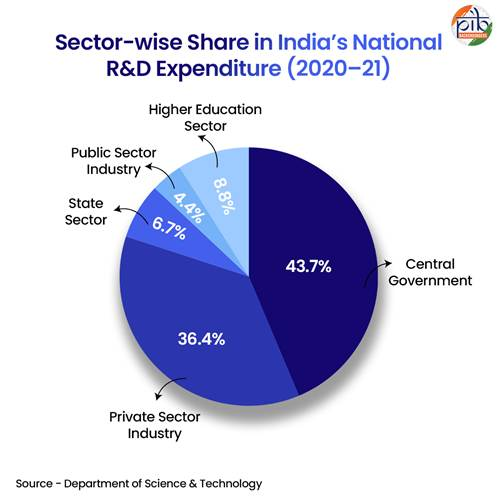
- Another factor contributing to this is the relatively low investment by India’s private sector, accounting for only around 36%, whereas in the aforementioned countries, private sector contributions are more than 70%.
- The Central Government contributes 43.7% of total R&D expenditure.
Need for Funding in R&D
- Economic Growth: Drives new industries, improves productivity, and enhances global competitiveness.
- Technological Advancement: Facilitates breakthroughs in fields like AI, biotechnology, and renewable energy.
- Social Challenges: Helps address poverty, healthcare, education, and environmental sustainability issues.
- Job Creation: Innovation generates employment opportunities and stimulates entrepreneurship.
- Global Positioning: Positions India as a global leader in science, technology, and knowledge.
- Attracts Investment: Promotes foreign and domestic investments in research-driven sectors.
Government Initiatives
- Research, Development and Innovation (RDI) Scheme: Approved with a ₹1 lakh crore corpus, this scheme aims to energise private-sector R&D and deep-tech startups.
- It offers long-term, low- or zero-interest loans, equity investments, and funds a new Deep-Tech Fund of Funds via the Anusandhan National Research Foundation (ANRF).
- Anusandhan National Research Foundation (ANRF): The ANRF established in 2023, provides high-level strategic direction for research, innovation, and entrepreneurship in science and technology.
- The Foundation aims to mobilise funds amounting to ₹50,000 crore during 2023–28 through multiple streams, including the ANRF Fund, Innovation Fund, Science and Engineering Research Fund, and Special Purpose Funds.
- National Geospatial Policy, 2022: It seeks to position India as a global leader in the geospatial sector by 2035.
- The policy liberalises access to geospatial data, encouraging its use in governance, business, and research.
- Indian Space Policy, 2023: It builds on the space reforms introduced in 2020, which opened the domain to non-governmental entities for end-to-end participation.
- It aims to enhance space capabilities, promote a flourishing commercial space industry, and foster collaboration between public and private entities.
- National Quantum Mission: Allocated ₹6,003.65 crore for 2023–31, to advance quantum technologies through scientific and industrial R&D.
- BioE3 Policy, 2024: It encourages the creation of Biomanufacturing and Bio-AI hubs, along with a national Biofoundry network, to accelerate technology development and commercialisation.
- National Supercomputing Mission (NSM): Launched in 2015, the initiative empowers universities, research institutions, and government agencies with state-of-the-art supercomputing systems connected through the National Knowledge Network.
- India Semiconductor Mission (ISM): Established in 2021, the mission seeks to build a robust ecosystem for semiconductor and display manufacturing.
- India has already approved 10 semiconductor projects across six states, including the first commercial Silicon Carbide fabrication facility in Odisha.
- India AI Mission: The IndiaAI Mission embodies the vision of “Making AI in India and Making AI Work for India.”
- It is advancing rapidly, having already increased computing capacity from an initial target of 10,000 GPUs to 38,000 GPUs, ensuring accessible AI infrastructure for startups, researchers, and industries.
- Atal Innovation Mission (AIM): To foster innovation at the grassroots level by providing support to students, startups, and entrepreneurs.
- The National Mission on High-Yielding Seeds will focus on strengthening the research ecosystem and developing high-yielding, pest-resistant, and climate-resilient seeds, aligning with DBT’s efforts in agricultural biotechnology.
Source: IE
Previous article
Declining Fertility Rate in India
Next article
India’s Textile Industry Weaves a New Growth Story
